Both the Vortex Venom Enclosed and the Vortex Defender ST Enclosed are built on the DeltaPoint Pro (DPP) footprint, both are enclosed emitters, and both carry the Vortex Lifetime Warranty. On paper, they look like close competitors. In practice, the differences between them are meaningful enough to steer most buyers clearly in one direction.
This comparison breaks down what each optic offers, where they share ground, and where they diverge, so you can make an informed choice before spending your money.
|
Starts at $199.99 
|
Starts at $379.99 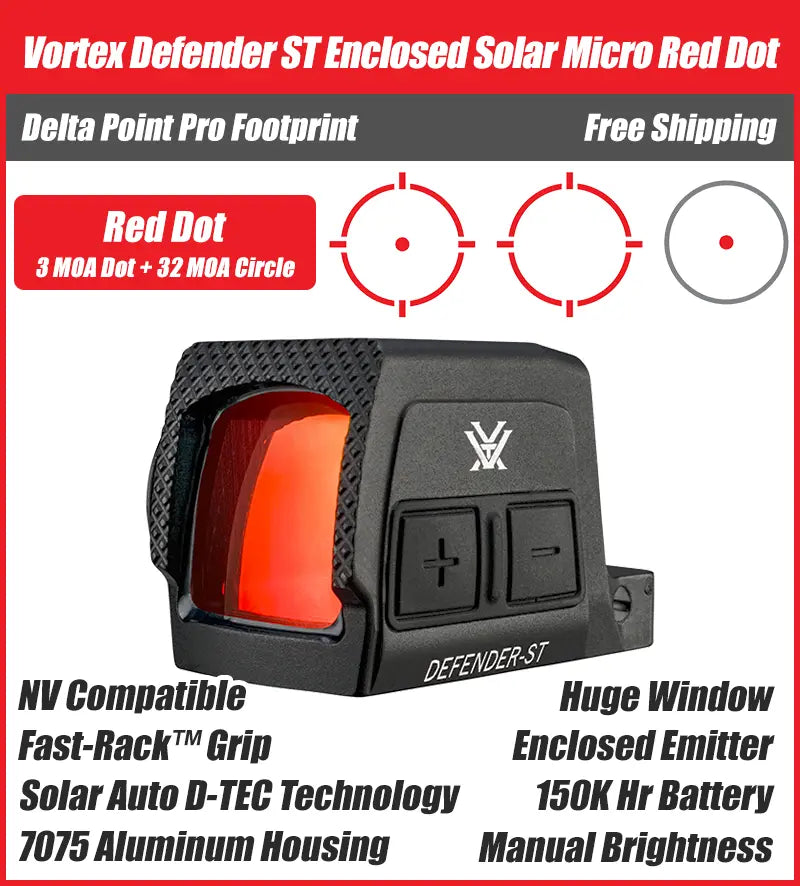
|
TL;DR
The Venom is a capable enclosed red dot priced at $199.99. The Defender ST is a more durable, feature-rich option at $379.99. If you want a clean, reliable enclosed emitter at an accessible price point, the Venom delivers. If you are running the optic hard in a duty or high round count environment, the Defender ST justifies the premium with tougher construction, significantly longer battery life, a more versatile reticle system, and better dot clarity.

Quick Specs
The Defender ST and Venom Enclosed share a lot of DNA as Vortex enclosed emitters, but the spec differences below are what drive the price gap. Here are the main specifications for both optics:
|
Vortex Venom Enclosed |
Vortex Defender ST Enclosed |
|
|
Footprint Type |
DeltaPoint Pro |
DeltaPoint Pro |
|
Reticle Color Options |
Red Dot |
Red Dot (MRS) |
|
MOA Options |
3 MOA or 6 MOA |
3 MOA Dot / 32 MOA Circle |
|
Battery Type |
CR2032 |
CR2032 |
|
Solar Failsafe |
No |
Yes |
|
Fast Rack Texturing |
No |
Yes |
|
Battery Life |
Up to 20,000 Hours |
35,000 hrs (battery) / 150,000 hrs (with solar) |
|
Brightness Levels |
12 Settings, 10 daylight/2 NV |
12 Settings, 10 daylight/2 NV |
|
Window Dimensions |
23mm x 20mm |
23mm x 20mm |
|
Dimensions (L x W x H) |
1.84" x 1.27" x 1.2" |
1.8" x 1.3" x 1.2" |
|
Weight |
1.75 oz |
1.6 oz |
|
Housing Material |
6061 Aluminum |
7075 Aluminum |
|
Warranty |
Lifetime |
Lifetime |
|
Price |
$199.99 |
$379.99 |

Design and Housing
Both the Venom and Defender ST are enclosed optics, meaning a second plane of glass sits behind the emitter and the emitter itself is fully encased in the housing. This design adds protection and durability compared to open emitter sights and is generally preferred for duty and defensive applications.
The housing material is where they diverge. The Venom Enclosed uses 6061 aluminum, which is a solid, lightweight alloy used across most of the optics industry. The Defender ST steps up to 7075 aluminum, a harder and more impact-resistant alloy commonly found in mil-spec and premium duty gear.
The Defender ST also features a fast rack textured face, which allows you to rack the slide against the optic under stress without risking damage to the housing or lens. The Venom Enclosed does not have this feature.
Button Placement
The solar panel on the Defender ST occupies the top of the housing, which moved the control buttons to the left side. On the Venom Enclosed, the buttons sit on top and are slightly larger since no solar panel is competing for that space. Neither layout is objectively better, though side-mounted buttons may feel less intuitive initially if you are transitioning from a top-button optic.
Deck Height
Once mounted, the Venom Enclosed sits at a slightly higher deck height than the Defender ST. For duty or defensive builds where co-witnessing backup iron sights matters, that difference is worth factoring into your setup.
Footprint and Mounting
Both optics use the DeltaPoint Pro (DPP) footprint, which features four recoil lugs (one at each corner) and two screw holes toward the rear of the optic. This footprint is most common on full-size pistols and is one of the more widely adopted standards in the industry.
Direct Mount Platforms
A handful of modern pistols have slides cut natively for the DPP footprint, allowing direct mounting with no adapter plate required:
- Sig Sauer P320 (optics-ready variants with Romeo 1 Pro / DPP cut, including XSeries, M17, M18, and Legion models)
- Sig Sauer P226 / P229 (Legion and Pro Cut variants with Romeo 1 Pro cut)
- Springfield Armory Echelon (via the Variable Interface System, which accepts the DPP footprint natively)
- Staccato / 2011 DPO models (the factory DPO cut accepts the DPP footprint directly)
Adapter Plates and Alternative Mounts
For the vast majority of optics-ready handguns, a gun-specific adapter plate is required to convert the slide's proprietary cut to the DPP footprint. This includes:
- Glock MOS Models: Requires a Glock MOS to DPP adapter plate
- Walther PDP: Requires a Walther-specific adapter plate milled for the DPP footprint
- FN 509 / FN 510 / FN 545: Requires an FN-specific adapter plate for the proprietary Low-Profile Optics Mount System
- FNX-45 Tactical: Requires a dedicated adapter plate for the factory optic mounting system
- CZ P10 Series: Requires a CZ-specific adapter plate
- Springfield Armory 1911 TRP AOS: Requires a DPP-footprint AOS plate (A15B) for the Agency Optic System
Note that using an adapter plate will raise the deck height of either optic. For platforms not listed above, Freedom Gorilla's adapter plate finder can help match the correct plate to your specific pistol.
Reticle Options

The Venom Enclosed is a dot-only optic, available in 3 MOA or 6 MOA. This keeps the sight picture clean and uncluttered, which suits shooters who prefer a single, precise aiming point across all distances.
The Defender ST uses a Multi Reticle System (MRS), toggling between a 3 MOA dot, a 32 MOA circle, or both simultaneously. The 32 MOA circle accelerates close-range target acquisition, while the 3 MOA dot handles precision work at distance. Running both together gives a clear focal hierarchy for fast transitions.
On dot clarity, the Defender ST has a measurable advantage. Its higher refresh rate and more current emitter technology produce a cleaner dot with less smearing or lag, which is noticeable when comparing the two side by side.
Battery Life and Solar
Both optics run on a CR2032 battery, included in the box. Both feature a side-mounted battery tray that allows a swap without removing the optic from the pistol, which is a practical advantage in a duty or carry context.
The side-mounted tray does add some width to each optic. If you are running either on a full size pistol for concealed carry, confirm holster compatibility before purchasing.
On battery life, the Defender ST is the clear leader at 35,000 hours compared to 20,000 hours for the Venom.
The Defender ST extends this further with its Solar with Auto D-TEC Technology feature. The solar panel on top of the housing collects ambient light and offsets battery consumption when you are outdoors, pushing total runtime to up to 150,000 hours. It does not charge the CR2032 directly; it reduces draw on the battery, which is an important distinction.
Brightness and Power Management
Both optics offer 12 brightness settings, 10 daylight and 2 night vision compatible, cycled with the plus (+) and minus (-) buttons.
Both include motion-activated auto on/off with a 10-minute auto-shutoff. The dot powers down after 10 minutes of inactivity and reactivates automatically when the gun is picked up. Auto-shutoff can be disabled on both optics, placing full responsibility for power management on the shooter.
Button Lockout is available on both, preventing accidental brightness changes from an unintended button press while holstered.
Similarities and Differences Between the Venom Enclosed and Defender ST
Here is a quick reference breakdown of where the Defender ST and Venom align and where they split:
Similarities
- DeltaPoint Pro footprint
- Enclosed emitter design
- Side-mounted CR2032 battery tray
- 12 brightness settings (10 daylight / 2 NV)
- Motion-activated auto on/off with 10-minute auto-shutoff
- Button Lockout
- Parallax-free, unlimited eye relief
- Waterproof, fogproof, shockproof construction
- Vortex Lifetime Warranty
Differences
- The Defender ST Enclosed uses 7075 aluminum; the Venom Enclosed uses 6061
- The Defender ST Enclosed has fast rack texturing; the Venom Enclosed does not
- The Defender ST Enclosed has Solar with Auto D-TEC Technology; the Venom Enclosed does not
- The Defender ST Enclosed buttons are side-mounted; the Venom Enclosed buttons sit on top
- The Defender ST Enclosed battery life is 35,000 hours (150,000 with solar) vs. 20,000 hours for the Venom Enclosed
- The Defender ST Enclosed uses an MRS reticle (3 MOA dot / 32 MOA circle); the Venom Enclosed is dot only (3 or 6 MOA)
- The Defender ST Enclosed has a lower deck height than the Venom Enclosed
- The Defender ST Enclosed has a higher refresh rate and improved dot clarity
- The Defender ST Enclosed ships with an extended T-10 Torx; the Venom Enclosed does not
Which One to Choose
Both optics cover the same DPP footprint and share a lot of core features, but the differences are meaningful enough to point most buyers clearly in one direction. Here is how to think about it.
Choose the Vortex Venom Enclosed if you want a durable, reliable enclosed red dot at an accessible price point. At $199.99, it is a strong entry point for shooters new to pistol optics who still want the protection of an enclosed emitter backed by the Vortex Lifetime Warranty. The dot-only reticle in 3 or 6 MOA keeps things simple and effective for both precision and close-range work. There is nothing lacking here for a range gun, home defense build, or a shooter who does not need the additional features the Defender ST brings.
Choose the Vortex Defender ST if your optic needs to hold up under heavy, sustained use. The 7075 aluminum housing and fast rack texturing make it more resilient in duty and hard-use contexts. The Solar Failsafe and 150,000-hour runtime mean battery management is rarely a concern. The MRS reticle adds genuine versatility for different engagement scenarios, and the higher refresh rate delivers cleaner dot performance. At $379.99, it ships ready to run on both DPP cut and MOS cut pistols with no additional accessories required.
|
Starts at $199.99
|
Starts at $379.99
|
Final Verdict
The Vortex Venom Enclosed and Vortex Defender ST cover the same footprint, share the same core construction philosophy, and both represent solid value within their respective price tiers. The Venom is the leaner, more affordable choice for shooters who want a capable enclosed emitter without the premium features. The Defender ST earns its price with tougher construction, superior battery life, a more versatile reticle, and better optical performance under hard use.
Both are available at Freedom Gorilla with the full Vortex Lifetime Warranty. If you are still deciding, reach out to the team for a recommendation based on your specific platform and use case.